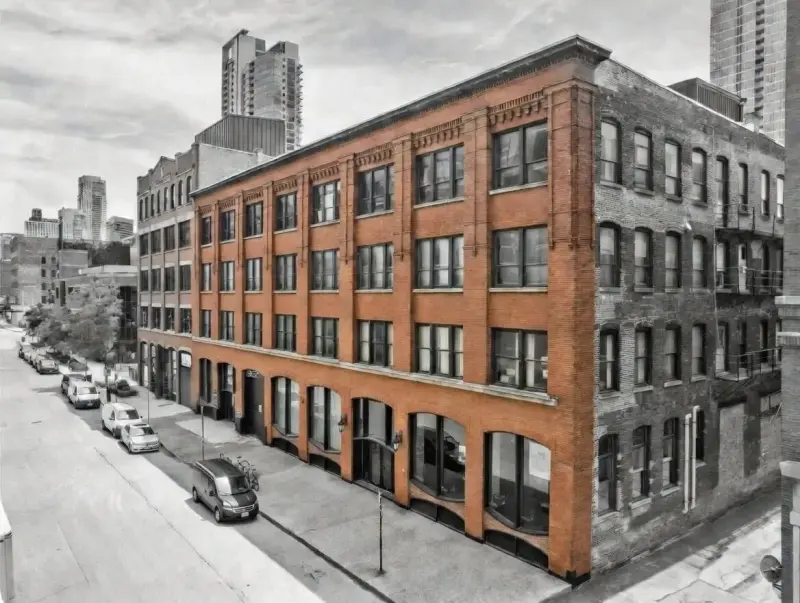
Before it held lofts, 401 W. Ontario held rags, rubber and iron — the headquarters of one of Chicago’s largest scrap houses, run by a family that helped turn America’s cast-offs into industry.
Smokey Hollow
The blocks west of Michigan Avenue grew up early as a working district. By the late 1850s the river and the rail lines had drawn heavy industry, and immigrant families settled the surrounding blocks. The Great Fire of 1871 leveled it all; industry rebuilt along the same lines. By the turn of the century the district had a name that told you everything about it: Smokey Hollow, for the haze the riverside factories kept overhead. It stayed industrial deep into the twentieth century — until a developer named Albert Friedman rechristened it “River North” in the late 1970s.
A rag peddler’s empire
Sigmund Birkenstein came to America from Kissingen, Germany in 1857, reaching Chicago in 1866, where the city directories list him as a peddler in the rag trade. By the late 1870s he had a partner, a firm — S. Birkenstein & Co. — and a building on Kinzie Street. His son Louis joined in 1890, and Henry, Albert and Milton followed; by the time Sigmund died in 1900, the letterhead read S. Birkenstein & Sons.
Under Louis, the firm outgrew rags and paper stock and moved hard into scrap metal and rubber. In 1905 the company put up a purpose-built headquarters at 401 W. Ontario Street: offices and shipping on the first floor, storage and baling on the second, sorting above. Business kept growing, and in 1912 architect H. M. Eichberg added a fourth story so seamlessly you have to squint to find the seam.
It was a working warehouse with front-parlor manners: red face brick across eight bays, segmental-arch windows, brick piers trimmed with Prairie-style ornament — and inside, the heavy timber posts and beams that carry the building to this day. The trade press called it the House of Birkenstein.
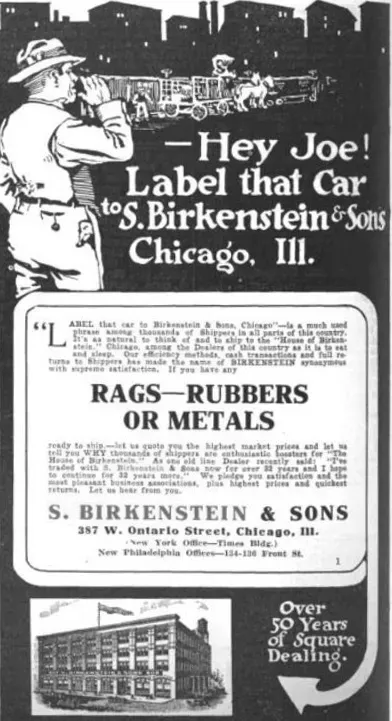
“Label that car to Birkenstein & Sons, Chicago” — a 1916 advertisement claimed the phrase was in daily use among thousands of shippers across the country.
The second century
The First World War made scrap a strategic material. The firm opened offices in New York, Philadelphia and Minneapolis, and Louis Birkenstein became the industry’s public face — four consecutive terms as president of the National Association of Waste Material Dealers. Success eventually moved the company out: in 1920 it decamped to North Avenue and Kingsbury Street, and the building passed through a century of tenants — paper stock, cork and seal, offices — its timber frame and brick walls left standing through every change of use.
A century of industry left the building remarkably intact. The conversion to Birken Lofts carries that record forward: fifty-seven residences set among the original posts, beams and brick, a block from the river that started it all. The full story — maps, portraits and the advertisements that named the house — is at birkenlofts.com/history.